PGA leaderboards rank the players in a tournament by score. For the PGA leaderboard today, use the tour’s own site or the broadcast. Behind every score, good swings stay close to one plane, and Striped measures your plane and tempo.
What PGA leaderboards show
A golf leaderboard lists the players in an event by score, with the leader at the top. It tells you who is ahead.
It does not show how anyone got there. Every number on the board is the sum of many swings.
What a score leaves out
The plane your hands travel on and your tempo are easy to check at practice. Neither appears on a scoreboard.
When both repeat from swing to swing, they can help your contact. That is the part of a tour player’s game you can practice on your own range.
Good swings stay close to one plane
A 2012 study of swing planarity measured 14 skilled golfers. Their clubhead moved on a well-defined swing plane. The slope of that plane changed with the club.
The same study called the downswing “semi-planar,” with a transition phase first and then a planar phase. The shoulder and arm points moved on different planes.
Great swings “stay as close as possible to being on plane,” says GOLF.com’s drill for keeping the club on plane. A plane you repeat can help your contact, shot after shot.
The drill’s check takes one tee. Stop your backswing at lead-arm parallel, where the grip end should point at a tee behind the ball. Outside the tee means too shallow, and inside means too steep.
The 3:1 rhythm behind the Tour pace
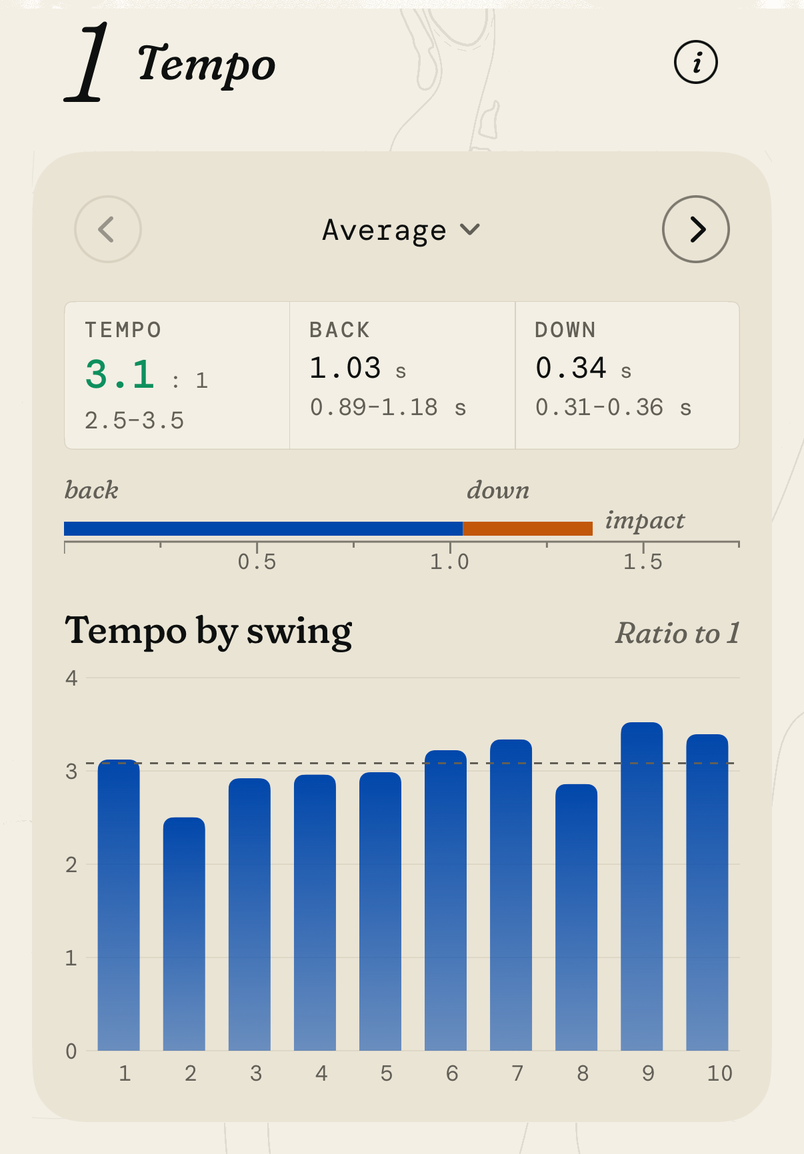
Tempo is your backswing time divided by your downswing time. At 3:1, the backswing takes three times as long. Tempo is a ratio, so it says nothing about how fast you swing.
Striped’s metronome names its 3:1 full-swing pace Tour, and it plays 800 ms back and 267 ms down. Silky, Tour and Speed all play 3:1 at different speeds. So you can keep the ratio and still swing at your own speed.
A steady ratio from swing to swing can help your contact. Hear the Tour pace in the free web metronome, or in AirPods during a Striped session.
The metronome is for practice only. USGA and R&A Rule 4.3 does not allow audio for swing tempo during a round, so leave the tones at the range.
How tempo moves from session to session
A leaderboard changes round by round. Your tempo changes session by session too, and Striped keeps each one.
Over 11 irons practice sessions, the session average ran from 2.25 to 3.05, with a median of 2.85 (example data from 11 practice sessions). Six of the 11 sessions landed inside the app’s starter band of 2.8 to 3.2.
| Measure | Ratio |
|---|---|
| Lowest session | 2.25 |
| Median session | 2.85 |
| Highest session | 3.05 |
| Spread in a session | 0.21 |
The spread is the number to follow. A small spread shows a rhythm that held from one swing to the next, whatever the session average was.
How to check your plane and tempo with Striped
Striped works with your iPhone in your front pocket, AirPods in your ears and Apple Watch on your lead wrist. Striped times your hands. Apple Watch finds the top where your hands reverse.
Reading the swing at the wrist is a studied method. A 2024 study of a single wrist-worn sensor tracked the wrist through the golf swing on 20 golfers.
Put your iPhone in your front pocket, your AirPods in, and Apple Watch on your lead wrist. Profile Devices shows whether your Apple Watch is ready.
On Practice, pick irons. Add a metronome pace if you want one, then hit balls with one club.
After each swing, you hear a soft chime, then your ratio read out in your AirPods.
Open the session report. The Tempo card shows your backswing, your downswing and the ratio.
The Path, plane & speed card shows the plane your swing ran on and the path your hands traced.
In Progress, each point is one club’s average for a practice day.
On the Path, plane & speed card, two readings describe your plane. Plane is how steeply your hands swing back, in degrees from level. Wobble is how far your hands stray from that plane.
A small, steady Wobble shows your hands held one plane. Pair it with the GOLF.com tee check. Check the position slowly, then hit full swings and read the card.
What to practice this week
Pick one part of the swing that no golf leaderboard shows, and give it one bucket. Work on plane or tempo, one at a time.
The golf tempo guide explains the ratio in more depth. The one plane vs two plane guide walks through the tee check step by step.
To fit the work into one bucket, use the driving range practice plan. Setup help is on the support page, and the home page shows everything else Striped measures.
Sources
- Keep your club on plane and hit better irons with this simple trick (GOLF.com)
- Assessment of planarity of the golf swing based on the functional swing plane of the clubhead and motion planes of the body points (Kwon et al., Sports Biomechanics, 2012)
- Enhancing accuracy and convenience of golf swing tracking with a wrist-worn single inertial sensor (Kim and Park, Scientific Reports, 2024)
- Striped: The paces the Striped metronome plays (backswing and downswing, in milliseconds).
- Striped: Tempo ratio (backswing / downswing, timed at the hands by Apple Watch), mean per irons practice session. (example data from 11 practice sessions)
- Striped: Striped times tempo at the hands. The top is where the hands reverse, read by Apple Watch on the lead wrist.
Cite or embed
Cite this guide: Nick. “The swing habits behind PGA leaderboards.” Striped, 6 Nov 2026. https://stripedgolfapp.com/guides/pga-leaderboards/
Embed a diagram
The diagrams are free to use with credit. Copy the code for one:
A swing that stays close to one plane, seen down the line
<a href="https://stripedgolfapp.com/guides/pga-leaderboards/#figure-repeat-plane"><img src="https://stripedgolfapp.com/guides/pga-leaderboards/repeat-plane.svg" width="420" height="282" alt="A down-the-line sketch of a golfer at address with a tilted line drawn through the ball and the hands. The hand path climbs along that line to the top and comes back down close beside it."></a><br>Diagram: <a href="https://stripedgolfapp.com/guides/pga-leaderboards/">The swing habits behind PGA leaderboards</a>, Striped