PGA championships are the tournaments where tour professionals play for a title. For tickets, dates and live scores, use the organizer’s official site or the broadcast. The part you can take to the range is a steady tempo, and Striped measures yours with your iPhone, AirPods and Apple Watch.
What PGA championships show
Each one ends with one name at the top of the board. The PGA leaderboards guide explains what a board shows, and what it leaves out.
The final score is the sum of many swings. Tour data describes those swings across whole fields of players.
Where to find tickets and scores
For tickets for PGA Championship events, go to the organizer’s official site. Check the dates and the host course there too, before you plan a trip.
For PGA Championship scores during play, use the tour’s own site or the broadcast. This guide does not track results. It covers what you can practice after you watch.
Where tour numbers come from
Golf championships are also a source of data. The R&A and USGA’s research on driving distance draws on about 285,000 drives a year from seven professional tours.
Even at that level, players vary. In the 2016 season, the 10 shortest-ranked players were about 6% shorter than average.
Trackman’s published tour averages for 2023 are vendor data from 40+ events and 200+ players, mostly on the PGA TOUR. They mix shots from competition and the range. Trackman picked official stat holes in opposite directions to reduce wind effects.
Both sources describe tour players, so no amateur number can be worked out from them. The golf club distance chart prints Trackman’s tables club by club.
The part of tour golf you can practice
You cannot copy a tour player’s length. You can practice a steady rhythm, because a ratio fits any swing speed. A steady tempo can help your contact.
Tempo is your backswing time divided by your downswing time. At 3:1, the backswing takes three times as long. A ratio near 3:1 is a common tour norm for full swings.
That norm describes how tour players swing. The ratio says nothing about how fast you swing.
Striped’s metronome plays 3:1 at different speeds. Silky runs 900 ms back and 300 ms down, Tour runs 800 ms and 267 ms, and Speed runs 600 ms and 200 ms.
So you can keep the ratio and still swing at your own speed. Hear each pace in the free web metronome, then pick the one that feels like your swing.
Keep tempo audio for practice
The metronome is for practice only. USGA and R&A Rule 4.3 does not allow audio for swing tempo during a round.
So keep the tones, the beats and the spoken ratio for the range. Never use them on the course in play.
How your tempo moves from session to session
Tour averages pool many players. Your own tempo is a number you can follow over time, one session after another.
Across 11 irons practice sessions in Striped, the middle half sat between 2.63 and 3.03, around a median of 2.85 (example data from 11 practice sessions). The highest session averaged 3.05 and the lowest 2.25. Inside a session, the median swing-to-swing spread was 0.21.
Read the spread as well as the average. A small spread shows a rhythm that held from one swing to the next, whatever the session average was.
How to check your tempo in Striped
Striped works with your iPhone in your front pocket, AirPods in your ears and Apple Watch on your lead wrist. Striped times your hands. Apple Watch finds the top where your hands reverse.
Put your iPhone in your front pocket and your AirPods in. Wear Apple Watch on your lead wrist.
Open Profile Devices. It shows whether your Apple Watch is ready.
On Practice, choose Irons. Add a metronome pace if you want one, such as Tour.
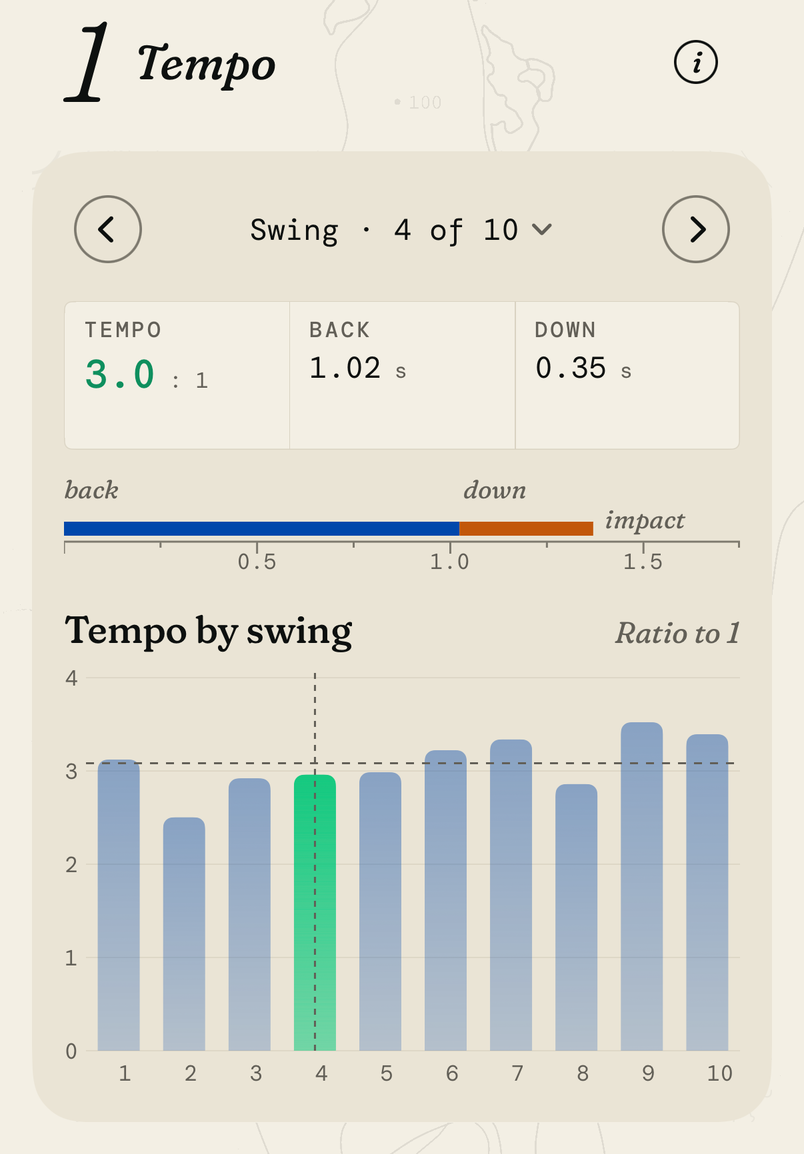
Hit balls with one club. After each swing, you hear a soft chime, then your ratio read out in your AirPods.
Stop from iPhone or Apple Watch, then open the session report. Tempo, Back and Down show the average.
Step to one swing to see its own numbers. In Progress, each point is one club’s average for a practice day.
Taking a championship to the range
When you watch golf championships, pick one habit to take to practice. Tempo is a good first pick, because it asks for no new positions.
Give it one bucket at a time. The driving range practice plan shows how to split the balls. The golf tempo guide explains the ratio in more depth.
Setup help is on the support page. The home page shows what else Striped measures, such as hip turn, head movement, swing plane and hand path.
Sources
- Research on Driving Distance in Golf Published (The R&A)
- New PGA & LPGA Tour Averages (Trackman)
- Striped: The paces the Striped metronome plays (backswing and downswing, in milliseconds).
- Striped: Tempo ratio (backswing / downswing, timed at the hands by Apple Watch), mean per irons practice session. (example data from 11 practice sessions)
- Striped: Striped times tempo at the hands. The top is where the hands reverse, read by Apple Watch on the lead wrist.
Cite or embed
Cite this guide: Nick. “PGA championships and the swing habit you can practice.” Striped, 8 Nov 2026. https://stripedgolfapp.com/guides/pga-championships/
Embed a diagram
The diagrams are free to use with credit. Copy the code for one:
Three 3:1 metronome paces in Striped, from Silky to Speed
<a href="https://stripedgolfapp.com/guides/pga-championships/#figure-three-paces"><img src="https://stripedgolfapp.com/guides/pga-championships/three-paces.svg" width="420" height="194" alt="Three pairs of bars on one time scale, for the Silky, Tour and Speed paces. In each pair the backswing bar is three times as long as the downswing bar, and both bars get shorter as the pace gets faster."></a><br>Diagram: <a href="https://stripedgolfapp.com/guides/pga-championships/">PGA championships and the swing habit you can practice</a>, Striped